

Read on below to lean more about the trends in garden design for 2017.
Color Blocking
A trend in women?s fashion, color blocking is the use of discrete blocks of colors, and it?s making a splash in outdoor living spaces too. Noting the number of color blocked patio walls that she?s seeing on Pinterest and around Los Angeles, Potted co-owner Annette Gutierrez says, ?It?s about framing or highlighting a specific plant or area.? A flash of color on a wall, for instance, can frame a row of potted plants or be the artful backdrop to an outdoor sofa. ?It?s exhilarating and oh so inexpensive to do!? she adds. And if you don?t have a wall to paint, you can always use a solid-color outdoor rug or porch curtains to create the effect.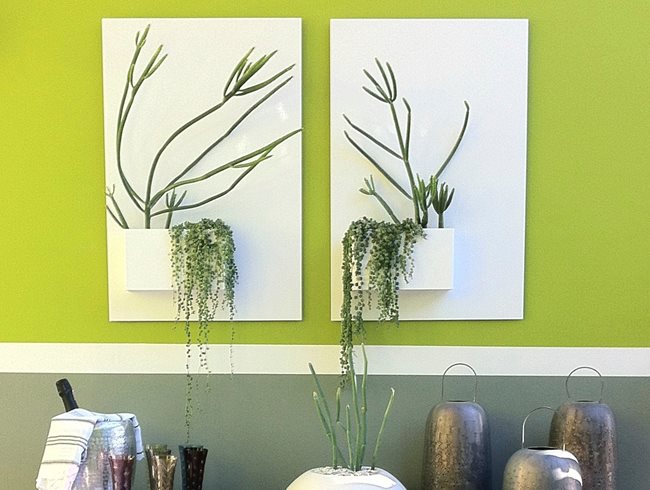
Blocks of chartreuse and sage green are set off with a crisp white stripe. Two white City Planters on the wall provide another block of solid color. Photo courtesy of Potted.
Hyperlocalism
?Locally sourced? continues to be a buzzword in many industries, and garden designers too are seeing interest not just in native plants but endemic plants?those native to a very particular ecosystem. Tait Moring, a landscape architect who often designs ranch properties in central Texas, says, ?We?re planting more local and endemic plants, not just natives.? These aren?t always readily available in the nursery trade, so he transplants existing plants where he can. Even building materials are sourced hyperlocally. ?We use existing rocks and make posts from on-site junipers when possible.?
Such hyperlocalism is part of a trend that Susan Cohan, a New Jersey designer, calls a celebration of regionalism. Using native plants and locally sourced materials has been popular for years, she acknowledges. ?What?s new,? she says, ?is the impact that climate change is having on each region and how that drives design. More rain, drought, increased snowfall, no snowfall, cataclysmic weather events?these are all factors. Add local rules for impervious coverage, chemical runoff, and storm-water retention, and you have the basis for intense regional, even local, design qualities.? The designer’s challenge, she says, has always been to find the balance between natural elements and human wants and use. ?The answer to that challenge today is regionally focused design.?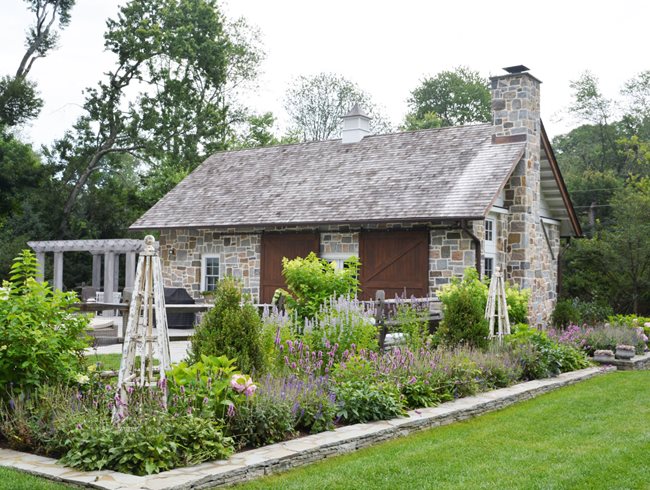
Sourcing materials locally helps reduce carbon emissions. This garden, designed by Susan Cohan, APLD, was created to reflect regional aesthetics and climate issues. Everything was sourced or grown locally. Native and non-native plants were chosen to survive active deer browsing and to actively encourage pollinators. Bluestone remainders from other parts of the project were incorporated as stepping and wall stones to reduce waste and the project’s carbon footprint. Vintage elements add to the overall reuse of materials.
See more at the Garden Design Magazine
Feature Photo courtesy of Land Morphology.


