

Read on below to discover more of these red flowers for gardens from coast to coast.
4. ?Valentine? Bush
(Eremophila maculata ?Valentine?)?Valentine? bush hails from Australia, and it thrives in hot, dry climates like that of its native country. Reaching 4 feet tall and 4 to 5 feet wide, it provides arid landscapes with deep red color from December through February, when not much else is going on in the landscape.Bloom season: Throughout the year in Zone 9 and above; in Zone 8, flowers appear in spring through fall
Cold tolerance: Hardy to 15 degrees Fahrenheit, or minus 9.4 degrees Celsius (Zone 8)
Origin: Australia
Water requirement: Low
Light requirement: Full sun
When to plant: Spring or fall5. Indian Pink
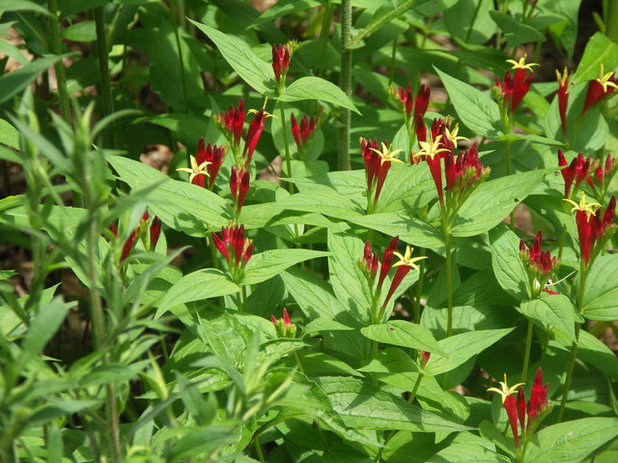
(Spigelia marilandica)Indian pink fills a void in the hummingbird garden, with its crimson and yellow tubular-shaped flowers appearing in late spring or early summer in dappled shade or full shade. It is considered a top native plant for attracting hummingbirds, and grows in upright clumps to 1 foot to 2 feet tall and about 1 foot wide.Caution: All parts of the plant are considered poisonous.Bloom season: Late spring or early summer
Cold tolerance: Hardy to minus 30 degrees Fahrenheit, or minus 34.4 degrees Celsius (zones 4 to 9)
Origin: The southeastern U.S., from Maryland south to Florida and west to Texas
Water requirement: Prefers moist soils; does not tolerate drought
Light requirement: Prefers dappled shade to full shade
When to plant: Spring6. Dwarf Weeping Bottlebrush
(Callistemon viminalis ?Little John?)While bottlebrushes are typically trees, this dwarf variety tops out at 2 to 3 feet tall and wide. The bright red flowers really pop against the bluish leaves, which are attractive even when the plant is not in bloom. Dwarf weeping bottlebrush, like all bottlebrushes, features flower spikes that resemble those of other bottlebrushes and attract hummingbirds.


See more at Houzz
Pages: 1 2


Beautiful!
Molly Adair Radford
Can?t get to number 7